
At a glance
Küt is played by four players with 106 Okey tiles. Every round has a contract, such as “one Küt group of three” or “two runs of three”. On your turn, you draw a tile, lay down your groups if you have made the contract (meld), and discard one tile. On subsequent turns after melding, you can add tiles to groups on the table. The player who discards their last tile ends the round and scores 0; anyone who has not melded scores 500. At the end of the game, the lowest total score wins.
Tiles, the indicator tile and Okey
The set contains 106 tiles: the numbers 1 to 13 in red, black, blue and yellow, with two of each tile (104 tiles), plus two false jokers.
After the deal, one tile is turned face up as the indicator tile. Okey is the next number up in the same colour as the indicator tile. If the indicator tile is a 13, Okey is the 1 of that colour.
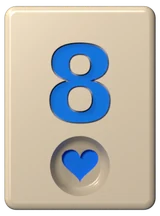
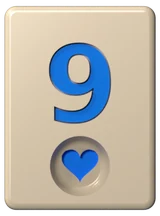 okey
Okey (the wild tile) can stand in for any tile you need: it fills a gap in a run or supplies a missing colour in a group. There are two Okey tiles in the set.
The false joker is not wild. It only stands for the number and colour of the Okey tile itself; in the round above, the false joker counts as a blue 9 and cannot replace any other tile. See the glossary for details.
The deal
The player who starts the round receives 15 tiles, and everyone else gets 14. Because the starting player already holds an extra tile, their first move is to discard rather than draw. The remaining tiles form the face-down draw pile.
At a physical table, the tiles are turned face down, shuffled and usually arranged in stacks of five before dealing. Agree beforehand who deals first and which direction play moves around the table; whatever you are used to in Okey applies here too.
Küt groups, runs and pairs
Küt group
The same number in different colours. A group consists of three or four tiles, and no colour may be repeated.
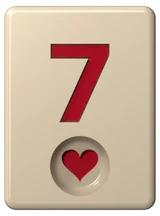
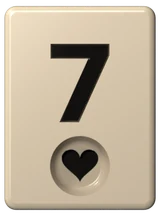
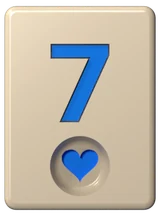
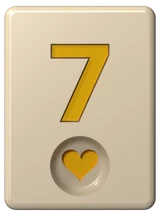
Run
Consecutive numbers in the same colour. A run has at least three tiles and can be extended further. The 1 can also follow 13: 12-13-1 is a valid run, whereas 13-1-2 is not.
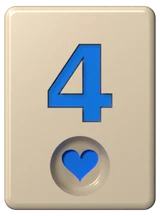
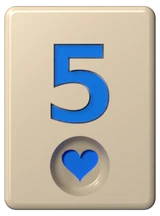
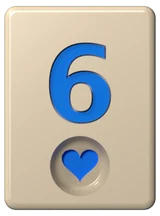
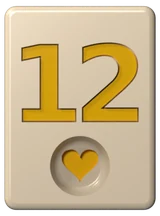
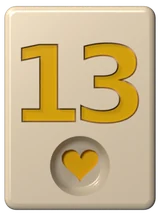
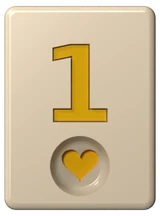
Pair
Two identical tiles of the same number and colour. Pairs are used only in contracts that call for them and in the final all-at-once round; you cannot add tiles to a pair.
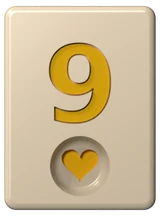
Okey can stand in for a missing tile in any group.
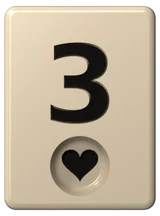 okey
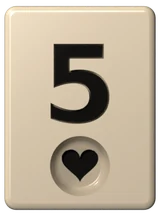
Contracts: the goal for each round
Every round sets a requirement for your opening meld. Some players call it the task, others the rule or penalty. The opening round usually asks for one group of three, followed by one run of three, then two of each, and later groups of four and runs of five.
The groups in your opening meld must match the contract to that exact length. In a round that calls for a “group of three”, you cannot open with a four-tile group; you add the fourth tile after you have melded.
For the full list of all 20 rounds with an example for each, see Küt Okey rounds.
How a turn is played
- Draw a tile. Take one from the face-down draw pile, or take the tile just discarded by the player to your left.
- Meld or add tiles. If you have met the contract, you can meld; if you melded on an earlier turn, you can add tiles to the table. Neither is compulsory—you may wait.
- Discard a tile. End your turn by discarding one tile from your rack. Your discard lands in front of the player to your right.
Melding
Melding means laying down the groups required by the contract. When you meld, you lay down only the contract itself; any other completed groups on your rack stay there.
You cannot play to the table again on the turn you meld: on that turn, you may neither add a tile nor lay down a new group. From your next turn onwards, you can lay down new groups and add tiles to any group on the table. For that reason, rushing to meld as early as possible is not always the best play.
Adding tiles and taking Okey
On turns after you have melded, you can add tiles to any group on the table, whether you laid it down or an opponent did. You extend a run at either end, or add the missing fourth colour to a three-tile group. You cannot add tiles to a pair.
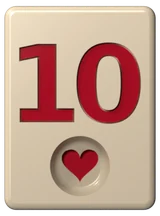
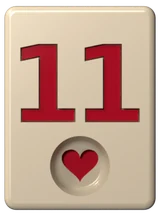
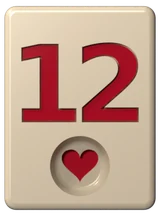
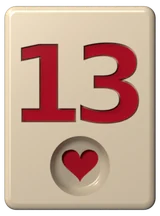
If a group on the table contains an Okey and you hold the actual tile it represents, you can swap your tile in and take the Okey onto your rack. In a Küt group, this is only allowed when the group has four tiles; in a three-tile group, a fourth tile must be added first. Taking Okey also counts as playing to the table, so you cannot do it on the turn you meld.
You must keep at least one tile on your rack to discard. You cannot end the round by adding your last tile to the table; a round ends with a discard. The only exception is the final, contract-free all-at-once round.
Buying the discard
The next player in turn always has first claim on a discarded tile. If they pass on it, another player out of turn can buy the discard: they take the discarded tile and also draw one penalty tile from the draw pile. Turn order does not change, and play continues from where it left off.
In KÜT, each player can buy the discard up to 5 times per round, and the option remains available after melding. Physical tables may use a different limit; see table rules.
Penalty discards
Two kinds of discard carry a penalty, forcing the player who threw the tile to draw 2 tiles from the draw pile:
- Discarding Okey. Okey can stand in for any tile, so throwing it to the table is a gift to an opponent.
- Discarding a playable tile. Throwing away a tile that could be added to a group already on the table. This penalty also applies to players who have not melded yet and to a player on the turn they meld.
If every tile on your rack would carry a penalty, you have no choice and the discard is not penalised. Likewise, no penalty tiles are drawn when fewer than two tiles remain in the draw pile.
Ending the round
The player who discards their last tile ends the round. Play stops immediately and everyone tallies the points left on their rack.
If the final discarded tile is an actual Okey, the round is finished with Okey and everyone’s penalty points are doubled.
In the final all-at-once round (which has no contract), there is no preliminary meld: a player who arranges their entire rack into valid groups in one go ends the round without needing a final discard. Finishing with Okey does not count in this round.
The draw pile can run out before anyone goes out. In the KÜT app, that round is redealt without scoring; if this happens a fourth consecutive time in the same round, the round is scored as normal. Around a physical table there is no single standard rule for an exhausted draw pile, so agree on one before you start.
Scoring and winning
- The player who ends the round scores 0.
- Anyone who has not melded scores 500.
- A player who has melded adds up the face values of the tiles left on their rack. Okey and false jokers count as 25 points each. That total is multiplied by 5 if Okey is red or black, or by 2 if it is blue or yellow.
- If the round was finished with Okey, all penalties are doubled: anyone who has not melded scores 1,000.
At the end of the game, the player with the lowest total score wins. For worked examples and a calculator, see the Küt Okey score calculator.
Team play
At a team table (TEAM), the two players sitting opposite each other are partners. When one player ends the round, their partner also scores 0, even if that partner never melded. All other rules remain the same. Team scoring and a sample round are covered on the Team Küt page.
You can find the rules for runs, groups and scoring in classic Okey on the standard Okey rules page.
Frequently asked questions
Can I add a tile before melding in Küt?
No. To add tiles to groups on the table, you must first meld the contract for that round. You cannot add tiles on the turn you meld either; your first chance is on your next turn.
Can I lay down more groups than the contract asks for when I meld?
No. Your opening meld must contain only the groups required by the contract. If you have other completed groups waiting on your rack, you can lay them down as new groups or add their tiles on later turns.
Does 12-13-1 count as a run?
Yes. The 1 can be used both as the lowest tile and as the tile after 13, so 1-2-3 and 12-13-1 are both valid runs. However, 13-1-2 is not a run; runs do not wrap around past 1. For other common disputes, see the table referee.
How many penalty tiles come with a bought discard?
One. If a player takes a discarded tile out of turn, they also draw one penalty tile from the draw pile. Turn order does not change.
Can I discard Okey?
You can, but it carries a penalty: you draw 2 tiles from the draw pile. Finishing the round with Okey, on the other hand, doubles everyone’s penalty points.